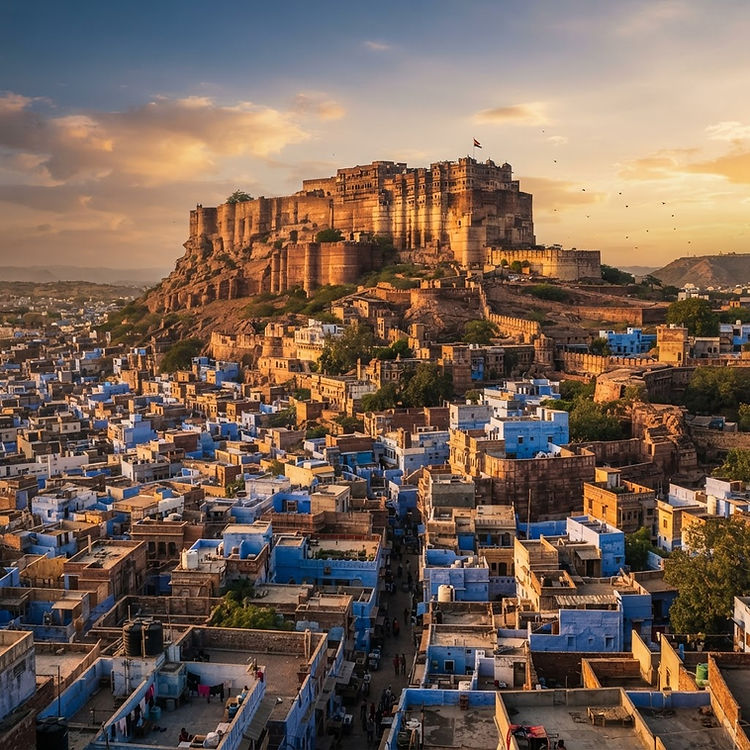
Mehrangarh Fort remains the most significant landmark in Jodhpur. Perched on a perpendicular cliff, its massive walls enclose a series of palaces, courtyards, and exhibition spaces. The fort represents the military and political history of the Rathore dynasty, illustrating how defensive structures were integrated with opulent royal residence designs. Its presence dominates the skyline and serves as a constant reference point for navigation within the city.
Nearby stands Jaswant Thada, a white marble memorial built to commemorate Maharaja Jaswant Singh II. This structure stands in stark contrast to the red sandstone of the city’s fort. Its intricate carvings and serene lakeside location highlight the refined artistic traditions that flourished in the region during the nineteenth century. The site remains a site of quiet contemplation.
These landmarks are essential to understanding the local historical narrative. They were built to project power and reverence, using materials sourced from the surrounding landscape. By maintaining these structures, the city preserves its connection to the past, allowing visitors to visualize the scale and ambition of the royal era.
Destinations in this story

Related articles

Exploring The Distinct Neighborhoods Of Cape
Cape Town comprises various districts that offer different experiences, from historic architecture and vibrant streets to modern residential areas and quiet suburban landscapes.
Significant Monuments Of The Cape Peninsula
Key monuments across Cape Town represent the complex historical trajectory of the city, serving as anchors for understanding both colonial impact and political change.
Planning A Day Around Iconic Attractions
Organizing a day in Cape Town requires balancing natural heights and maritime history, allowing enough transition time between mountain views and the bustling waterfront.